
Solar panels are well-known for being an excellent way to reduce electricity costs, improve your carbon footprint, and increase property value, but did you know that there’s more than one type of solar panel system available?
For Noosa residents, the choice usually comes down to an off-grid solar panel system or a grid-connected solar panel system. As you’ll learn below, while both types of system offer similar benefits, there are some key differences that you’ll need to be aware of. We’ll outline exactly what they are, as well as how to choose which one is right for your property.
Off-Grid vs Grid-Connect Solar Noosa: What’s The Difference?
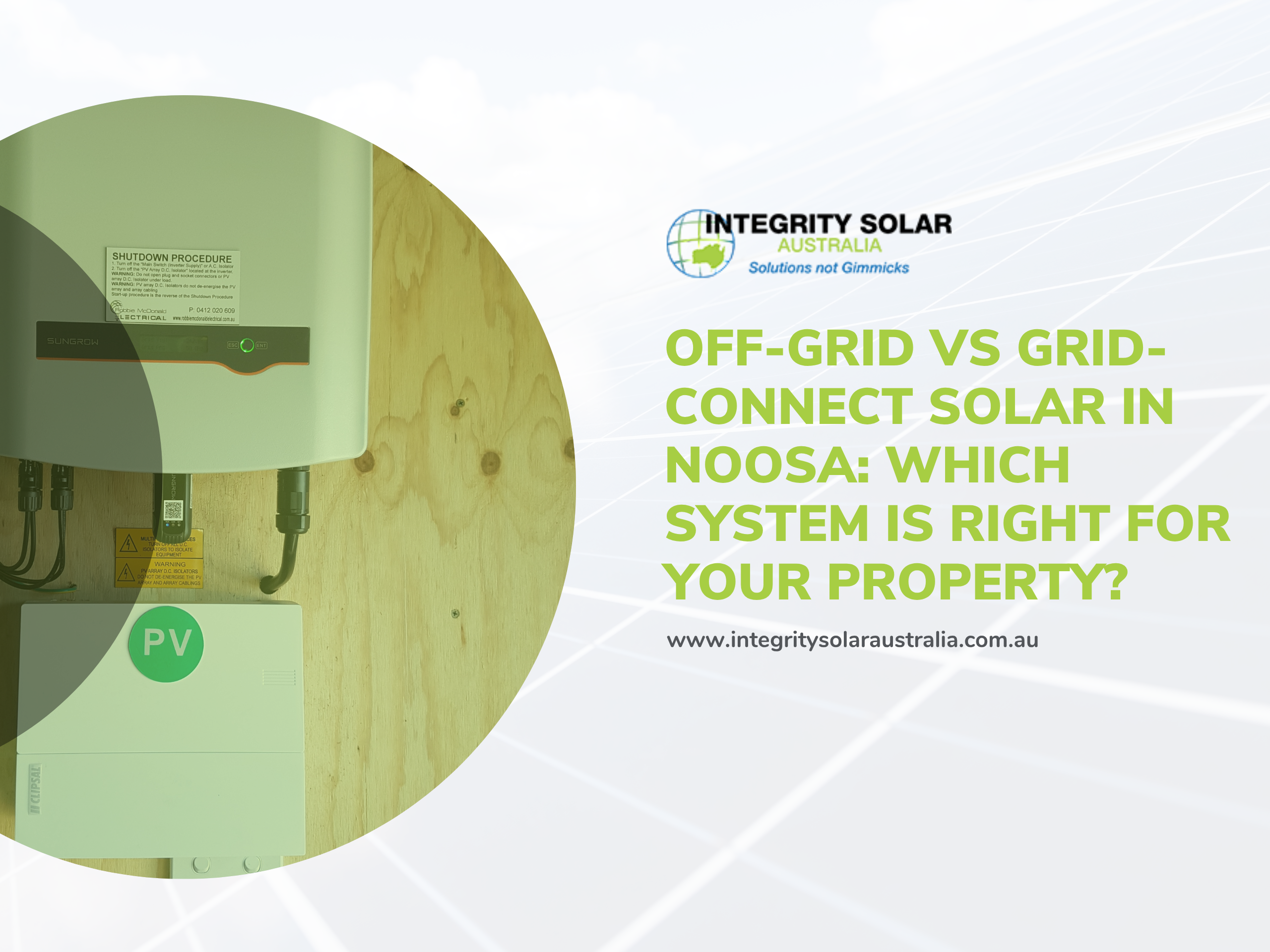
There’s one core differentiator between off-grid and grid-connected solar systems.
- Off-grid systems are not connected to Noosa’s main electricity grid.
- Grid-connected systems are connected to Noosa’s main electricity grid.
That might sound like a small difference, but it has a big impact on the overall functionality of the system.
Off-grid solar panel systems allow for full energy independence. Since the property can’t draw electricity from the grid, the solar panels are responsible for producing all the electricity that powers your home.
Off-grid solar systems lend themselves well to properties in remote areas that are currently not connected to the grid, as well as for homeowners who value full energy independence. You’ll need a solar storage battery to ensure your home has power at night.
Grid-connect solar panel systems are connected to the main electricity grid. That means that you’re not fully dependent on solar power to power your property. If it’s cloudy or nighttime, you’ll automatically draw from the grid. It’s also important to note that grid-connected solar systems feed both ways; you’ll draw from the grid when needed, but you can also sell excess electricity produced by your solar panels to the grid, too.
A Deeper Dive Into The Differences Between Grid-Connect Solar and Off-Grid Solar Noosa
Cost
Off-grid solar panel systems have a higher upfront cost than grid-connected solar systems, since, unlike grid-connected systems, the off-grid system has to work flawlessly year-round because there’s no backup power source. However, while you’ll pay more initially, the payback period can be faster since you’ll essentially be generating free electricity from day one.
Battery requirements
Solar batteries must be installed at the same time as the off-grid solar panel system. That ensures that the property has power at nighttime or during cloudy days. It’s not necessary to install a solar battery with grid-connected solar systems, though many homeowners choose to do so to maximise their energy savings.
Backup Power
Off-grid systems depend on a battery and backup generator to stay connected year-round, since there’s no backup system to fall back on. Grid-connected systems will automatically connect to the grid if there’s an issue with the solar system.
Reliability
Because they’re isolated and have no backup option of connecting to the grid, off-grid systems tend to be slightly less reliable than grid-connect solar systems.
However, off-grid systems can be more reliable during Noosa’s storm season, which can often bring blackouts to the grid that can leave homeowners with grid-connected systems without power.
Property Type
Grid-connect solar panel systems are best for properties that are already connected to the grid, especially those in urban areas. Off-grid systems are typically recommended for rural or harder-to-connect properties where solar power is the only viable energy solution.
Future Expansion
Grid-connected solar panel systems are generally easier to scale based on needs, with homeowners having the option to incrementally add more panels or a battery. Off-grid systems are harder to scale, since the core components often have to be upgraded if additional parts are added.
Long-Term Value
Both off-grid and grid-connect solar systems can provide long-term value. Off-grid systems, though more expensive upfront and requiring more maintenance than grid-connect systems, allow for full energy independence that can eliminate energy costs.
Grid-connect systems are less expensive upfront, but don’t completely eliminate energy bills. It is possible to sell excess power to the grid, however.
Off-Grid vs Grid-Connect Solar: Which One Is Right For Your Property?
Most homeowners find that their properties are automatically better-suited to one of the two main types of solar panels or the other. If your property is currently connected to the grid, then a grid-connected system is recommended. For rural properties that have an unreliable or non-existent grid connection, then an off-grid system will nearly always be recommended.
Need help choosing the right solar panel system for your property? Integrity Solar, the leading solar installation Noosa company, can provide a property assessment, solar system design, and full installation. To get started, call 0492 973 774.
More Posts You May Find Interesting
Solar panels are well-known for being an excellent way to reduce electricity costs, improve your carbon footprint, and increase property value, but did you know that there’s more than
If you're planning on going off-grid on a Noosa Hinterland property, you have quite a bit to learn. Sometimes connecting to the electricity grid can be expensive, impractical, or even
If you’re considering getting solar panels for your property, you might have found yourself struggling to determine which are the right choice for you. This is especially true if you

Solar power is a fantastic option for Gympie homeowners to become more self-sufficient and environmentally friendly. You can make use of the sun, one of the most renewable and
